Quick answer
Many Amish shops run machines from an engine through belts, air or hydraulic oil, and some groups use batteries and small solar panels. Any engine makes carbon monoxide, so never run one inside your home or an attached garage.
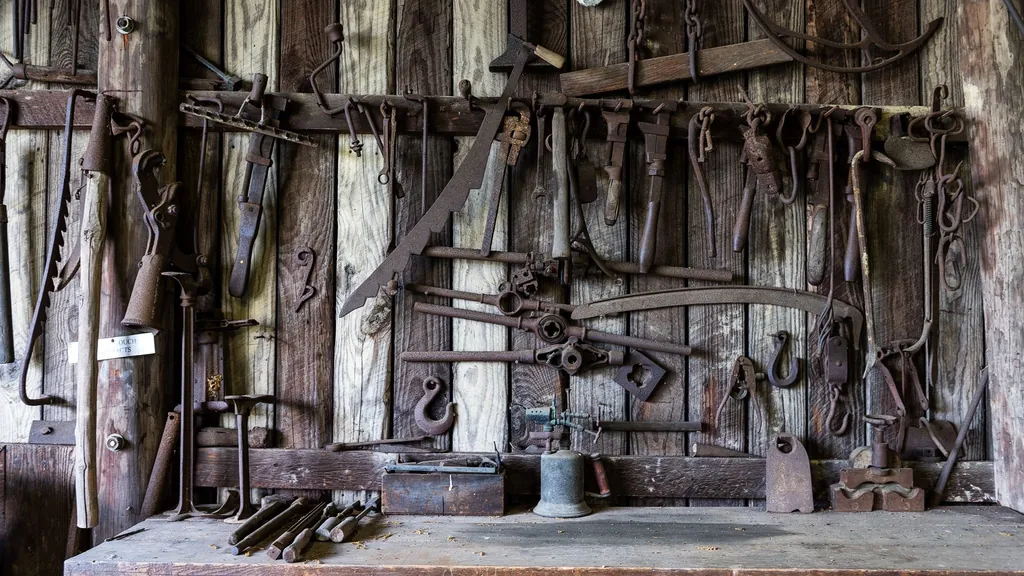
Workshop power without the grid
Amish woodworkers, harness makers, and furniture shops use full-size machinery, and wood products are the largest group of Amish-owned businesses.[1] In many church districts the power reaches the machines through belts, compressed air or hydraulic oil from an engine instead of through wires. What a district allows varies, and the rules are set by the local church.[2]
| System | How it works | What it runs |
|---|---|---|
| Line shaft | One engine turns a long overhead shaft. Flat belts drop down to each machine, and you slip a belt on or off to start or stop a machine | Table saws, planers, jointers, grain mills, washing machines |
| Pneumatic (air) | The engine drives an air compressor that fills large tanks. Air lines run through the shop and sometimes to the house | Air drills, sanders, nail guns, and air motors on sewing machines and mixers |
| Hydraulic | The engine drives a pump that pushes oil through hoses to hydraulic motors | Heavy saws, presses, lifts, water pumps |
| Batteries (allowed in many groups) | 12-volt batteries, often charged by a small solar panel or the shop engine | Lights, flashlights, cash registers, electric fences[3] |
| Solar (allowed in some groups) | Panels charge a battery bank for local use only, never tied to the grid | Batteries, electric fences, and in some homes, household appliances[3] |
Engines and carbon monoxide. Every engine that burns fuel makes carbon monoxide.[4] Never run an engine or a generator inside your home or an attached garage, even with the doors and windows open. Keep a generator outdoors and more than 20 feet from windows, doors and vents.[4] Put battery or battery backup CO alarms near every sleeping area.[4]
For a modern off-gridder. A small engine driving an air compressor or a 12-volt charging alternator gives you real shop power. A stand-alone solar battery system gives you lighting and small tools with no fuel at all. Both stay independent of the grid, in the Amish spirit. Have a licensed electrician do any wiring that connects a battery bank, a solar system or a generator to your house.
Engine upkeep. Change the oil and filters on the schedule in the engine maker's manual. Store fuel in approved containers away from the house, and follow the fuel and stabilizer labels on how long it keeps. Keep spare belts, filters, and air hose fittings.
Hand tools and upkeep
When the engine is down, hand tools still work. Buy quality tools once, used where you can, and keep them sharp.
| Job | Core hand tools |
|---|---|
| Woodcutting | Bow saw or two-man crosscut saw, felling axe, splitting maul, steel wedges, cant hook |
| Carpentry | Crosscut and rip handsaws, brace and auger bits, hand plane, chisels, mallet, square, level, hammer |
| Gardening | Spade, digging fork, hoes (draw and stirrup), wheel hoe, rake, scythe, pruning shears |
| Repair | Files, rasps, pliers, wrenches, hacksaw, vise, anvil, drawknife |
| Leather and harness | Awls, harness needles, waxed thread, rivets, punches, a stitching pony (clamp) |
| Sharpening | Mill bastard file, coarse and fine whetstones or diamond plates, honing oil, a foot-pedal grinding wheel |
Maintenance routine.
- Sharpen edges before they go dull. A few strokes often beats a long session later.
- Wipe metal with an oily rag after use. Store tools dry, hung on a wall.
- Treat wooden handles with boiled linseed oil now and then. Handle the used rags exactly as the oil can's label says.
- Replace broken handles yourself. Hickory and ash are the traditional handle woods.
Horses and draft animals
Many Amish farmers use draft horses or mules, often Belgians or Percherons, to plow, plant, mow, and haul. A team pulls ground-driven equipment, where the turning wheels power the machine. For local travel, most Amish groups rely on the horse and buggy.[5]
| Animal | Typical use | Notes |
|---|---|---|
| Draft horse (Belgian, Percheron) | Plowing, haying, logging, hauling | Large, calm and strong. Eats much more when working hard |
| Mule | Field work, including in hot climates | Known as hardy and sure-footed |
| Driving horse | Pulling the buggy | Lighter and faster than a draft horse |
| Pony | Children's cart, light chores | An easy keeper. Watch it closely on rich pasture |
What a horse needs.
- Land and feed: Pasture, plus hay for winter. Ask a large-animal vet or your county extension office how much your horse needs for its size and work.
- Shelter: A barn stall or a run-in shed out of wind and rain.
- Water: Clean water every day, and more when it works or the weather is hot. Keep it from freezing in winter.
- Hooves: Pick out hooves daily, and have a farrier trim or shoe them on a regular schedule.
- Harness: Check leather and stitching often. Oil the leather each season.
- Health: Vaccinations, deworming and dental care on a plan you make with a large-animal vet.
Learning. Driving and working horses is a skill that takes years. Learn from an experienced teamster, and start with a calm, older, well-trained horse.
Getting around
The Amish do not own cars, but they travel. For nearby trips they use a horse and buggy. For business and longer trips, many groups allow members to hire a local driver who is not Amish, and they may use buses, boats and trains, though not air travel.[5]
| Mode | Best for | Notes |
|---|---|---|
| Walking | Short trips | Free. Plan routes on back roads |
| Bicycle or adult tricycle with basket | Errands in town | Allowed in some groups and not in others. Add a trailer for groceries |
| Horse and buggy | Local trips | Needs a horse, harness, buggy, and stable |
| Pony cart or farm wagon | Farm and short errands | Hauls feed, firewood, and produce |
| Kick scooter | Short trips | Used in some communities where bicycles are not |
| Hired driver | Long trips, doctor visits, shopping | A local non-Amish driver with their own vehicle[5] |
| Bus and train | Long trips | Allowed, though air travel is not[5] |
Road safety for buggies. Use an orange slow-moving-vehicle emblem, reflective tape, and battery-powered lights, as your state requires. Most groups put battery lights on their buggies, while the most conservative use kerosene lanterns.[6] Avoid busy roads at dusk, and check your state's rules for animal-drawn vehicles.
Plan your life around short distances. Choose land close to a town, a store, a doctor, and neighbors. That makes it easier to live without a car, and it helps in any emergency.
The modern backup
For most homes, the modern backup for shop power is a portable power station for small loads and a generator for bigger ones. A generator belongs outdoors only, more than 20 feet from windows, doors and vents, with a battery CO alarm near every sleeping area.[4] For connecting anything to your house wiring, call a licensed electrician.
- What to do when the power goes out: safe generator use and the first three days.
- Winter storm checklist: fuel, light and travel before the storm hits.
- Heat, cooking and light: the Amish way to stay warm and see after dark.
Common questions
How do Amish shops run machinery without electricity?
Many use an engine that drives a line shaft with belts, an air compressor, or a hydraulic pump. Some groups also use 12-volt batteries and small solar panels.[3] What is allowed depends on the church district.[2]
Is it safe to run a generator or engine in a shop or garage?
Not inside your home or an attached garage. Every fuel-burning engine makes carbon monoxide. Run a generator outdoors only, more than 20 feet from windows, doors and vents.[4]
Do the Amish ever ride in cars?
They do not own cars, but many groups allow members to hire local drivers for business and long trips, and to use buses, boats and trains.[5]
Sources
- Occupations Young Center for Anabaptist and Pietist Studies, Elizabethtown College (Amish Studies), accessed November 14, 2026
- Regulations Young Center for Anabaptist and Pietist Studies, Elizabethtown College (Amish Studies), accessed November 14, 2026
- Technology Young Center for Anabaptist and Pietist Studies, Elizabethtown College (Amish Studies), accessed November 14, 2026
- Carbon Monoxide Poisoning Basics Centers for Disease Control and Prevention (CDC), accessed November 14, 2026
- Frequently Asked Questions Young Center for Anabaptist and Pietist Studies, Elizabethtown College (Amish Studies), accessed November 14, 2026
- Diversity Young Center for Anabaptist and Pietist Studies, Elizabethtown College (Amish Studies), accessed November 14, 2026
How this guide was made
This guide was drafted with AI writing tools, working from common Amish practice and the sources listed on this page. A separate fact-checking pass opened every cited source and checked each number, threshold and instruction against it; anything a source did not support was rewritten or removed. This page was reviewed by Marcus L. Barber on November 15, 2026. The photo is a licensed stock photo from Pexels (credit under the photo). It is not a photo of Marcus's home.
Amish practice varies by church district, and no Amish community or person has endorsed this guide or any product mentioned on this site.
This page has not been reviewed by a licensed electrician or food-safety professional. See our editorial standards. Spot an error? Email partners@digitalsolomon.com.