Quick answer
Burn seasoned wood, have the chimney inspected and cleaned each year, and keep anything that can burn at least 3 feet from the stove. Anything that burns fuel makes carbon monoxide, so put a battery CO alarm near every sleeping area.
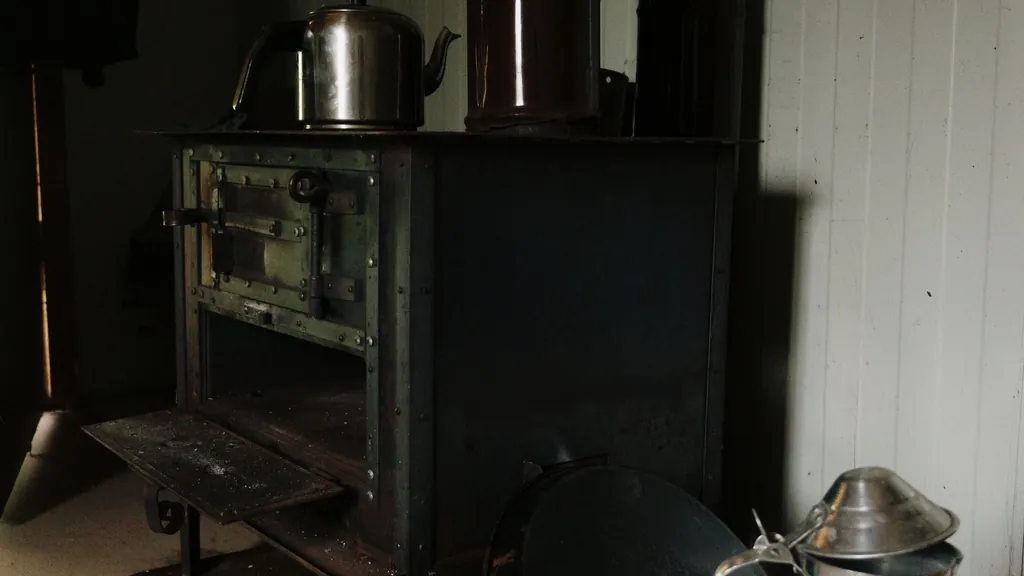
Heating with wood
Many Amish homes heat with one large wood or coal stove in the central room. Heat rises through floor grates to the bedrooms upstairs. Family life gathers around the warm room in winter, which saves fuel.
How much wood you need. A cord is the amount of wood in 128 cubic feet when it is stacked tight, such as a stack 4 ft high, 4 ft wide and 8 ft long.[1] How many cords you burn each winter depends on your climate, your stove, how well the house holds heat, and whether the cookstove runs all year. Ask neighbors who heat with wood, and keep a record of your first winter.
Seasoning. Split wood and stack it outdoors, off the ground, with only the top covered. Covering the sides traps moisture. Season it for at least six months. Wood burns best below 20 percent moisture, and a wood moisture meter will tell you.[2] Seasoned wood is darker, weighs less, and sounds hollow when you knock two pieces together. Never burn wet or green wood.[2]
Best firewood. Hard, dense species give the most heat: oak, hickory, ash, sugar maple, black locust, beech. Use softwoods like pine for kindling and quick spring and fall fires.
Woodlot. A well-managed hardwood woodlot grows new wood every year. If you cut only dead, crooked, and crowded trees, even a small woodlot can supply a home for a long time. A county extension forester can help you judge what your land can give.
Fire safety (do not skip):
Cooking on a wood cookstove
The wood cookstove is the heart of an Amish kitchen. One fire cooks, bakes, heats water, warms the room, and dries mittens. Many families also have a summer kitchen, a separate building or porch, so canning heat stays out of the house.
Parts of the stove
- Firebox: usually on the left. The cooktop is hottest directly above it.
- Oven: beside the firebox. A damper routes hot gases around it.
- Reservoir: a water tank on the far side.
- Warming closet: above the cooktop. It keeps food warm and proofs bread.
- Dampers: the flue damper controls draft and the oven damper sends heat around the oven.
Starting and running the fire
- Open the flue damper and oven damper fully, then open the air intake.
- Lay crumpled newspaper, a handful of thin, dry kindling, then a few split pieces about wrist-thick. Never start a fire with gasoline, kerosene, or charcoal starter.[2]
- Light it. Once the kindling is burning well, add larger split hardwood.
- Close the oven damper to send heat around the oven. Partly close the air intake to slow the burn.
- Feed small amounts often. A cookstove runs best on many small pieces, not one big log.
Controlling the temperature. You control heat by moving pots, not by turning knobs. Directly over the firebox is high heat (boil, fry). The middle is medium (simmer). The far end is low (keep warm, melt butter). Lift a lid off and set a pot directly over the flame for the fastest boil.
Baking. Most cookstove ovens have a thermometer on the door. Use it, and follow your recipe's temperature. A slow oven suits custards and slow beans, a moderate oven suits cakes and casseroles, and a hot oven suits bread, biscuits and pie crust. Turn pans halfway through baking, because the side nearest the firebox runs hotter. For bread, fire the oven hot, then let it fall back as the loaves bake.
Without a cookstove. A rocket stove burns small sticks very efficiently. A Dutch oven with coals underneath and on the lid bakes bread. Use both outdoors only, and never burn charcoal indoors.[4] A hay box (an insulated box) finishes stews and beans with little fuel after a good boil. Serve the food hot, and chill leftovers in a fridge at 40 F or below.[6]
Lighting after dark
Amish homes use flame light: kerosene in the most conservative groups, and pressurized gas or propane lamps in many others. Plan for one bright lamp where the family gathers, plus small lamps or flashlights to carry.
| Light | Fuel | Brightness | Notes |
|---|---|---|---|
| Flat-wick kerosene lamp | Clear K-1 kerosene | Low | Cheap and simple. Good for bedrooms and hallways |
| Mantle lamp | Lamp oil or clear K-1 kerosene, as the maker names[7] | Bright | Silent and bright. A good reading lamp |
| Pressure lantern | White gas (naphtha) or kerosene, as the maker names | Very bright | Lights a whole room or barn. Hisses. Hang it high, away from anything that can burn |
| Propane wall or ceiling lamp | Propane from the house tank | Bright | Needs proper venting and installation by a licensed gas fitter |
| Candles (beeswax, tallow) | Wax | Dim | Backup only. Never leave one burning in an empty room |
| Battery or solar flashlight | Batteries | Varies | No flame and no fumes. Most Amish groups use battery lights on their buggies[8] |
Lamp care. Trim the wick straight and flat so the flame burns evenly without smoke. Wash the chimneys in warm soapy water often. Use only the fuel your lamp's maker names, such as fresh, clear K-1 kerosene for many wick lamps.[7] Never put gasoline or white gas in a wick lamp.
Safety. Fill lamps outdoors and only when they are cool. Never leave a lit lamp unattended, and keep it at least 3 feet from curtains and anything else that can burn.[9] Lamps, lanterns and stoves that burn fuel give off carbon monoxide.[4] Keep the room ventilated, and keep a battery CO alarm near every sleeping area.[4] If a mantle lamp's light dims after an hour or two, the room may be short of fresh air.[7]
Using daylight. Amish schedules follow the sun. People rise early, do the heavy work in daylight, and go to bed early. Paint walls white or light colors, and place work tables by south-facing windows.
Keeping food cold
Many Amish households use a propane refrigerator, and some have a propane freezer too. Before propane, they used iceboxes, icehouses, springhouses, and cellars. Whatever you use, the food-safety lines are the same: keep the fridge at 40 F or below and the freezer at 0 F, and check both with an appliance thermometer.[6]
| Method | Temperature | How it works | What to store |
|---|---|---|---|
| Propane refrigerator | Set it to 40 F or below[6] | An absorption cycle driven by a small flame. Silent, with no moving parts. It burns propane, so vent it as the maker says[4] | Milk, meat, leftovers. Works like a normal fridge |
| Icebox | Often warmer than a fridge. Check it with a thermometer | An insulated cabinet with a block of ice on top. Cold air sinks over the food. Drain the meltwater daily | Milk, meat and leftovers only if it holds 40 F or below[6]. Otherwise produce and drinks |
| Icehouse | Holds winter ice into summer | Cut thick pond ice in deep winter. Stack the blocks in a shaded building packed with a thick layer of sawdust or straw on all sides | Supplies the icebox. Pond ice is for cooling, not for drinks |
| Springhouse | Cool, but usually warmer than a fridge | A small stone house over a cold spring or creek. Crocks sit in the running water | Produce, drinks, crocks. Milk and meat need 40 F or below[6] |
| Root cellar | Cool (32 F to 60 F) and moist; 90 to 95% humidity suits potatoes and root crops[10] | Dug into a hillside or under the house, with earth cover, a low intake vent and a high exhaust vent | Potatoes, carrots, beets, cabbage, apples. Squash and pumpkins want drier air, and onions and garlic keep best dry[10] |
| Cool pantry or north room | Canned goods keep best at 50 to 70 F[11] | An unheated room on the shady side of the house | Home-canned food in a clean, cool, dark, dry place[11]; onions, garlic |
| Frozen-food locker | 0 F[6] | Rent a locker at a community freezer or butcher in town | Meat after butchering |
Root cellar tips. Keep fruit away from vegetables, because fruit gives off ethylene, which speeds ripening.[10] So keep apples away from potatoes and cabbage. Many people pack carrots and beets in damp sand. Check stored food weekly and remove anything rotting.
Without cold storage, preserve instead. Can, dry, smoke, salt, or ferment food using tested methods (see Guide 4). Cook only what you can eat that day.
Staying cool in summer
Amish homes stay livable in summer through how they are built and how the day is planned.
- Summer kitchen: Do the cooking and canning in a separate building or screened porch.
- Cross-ventilation: Open windows on opposite sides of the house. At night, open the low windows downstairs and the high windows upstairs, so hot air rises out.
- Close up by day: Shut windows and pull shades in the morning, before the day heats up, to keep the cool night air inside.
- Shade: Plant leafy shade trees on the south and west sides. They shade the house in summer and let sun through in winter. Add porches and awnings.
- Schedule: Do heavy work early in the morning and in the evening. Rest during the midday heat.
- Body cooling: Wear loose cotton clothing and a wide-brimmed hat. Drink water often. Wet a cloth and wear it on the back of your neck. Sleep in the coolest room downstairs.
- Heat stroke: Signs include a body temperature above 103 F; hot, red, dry or damp skin; a fast, strong pulse; headache; confusion; and fainting. It is a medical emergency. Call 911, move the person somewhere cooler, and cool them with cool cloths or a cool bath. Do not give them anything to drink.[12]
The modern backup
In a short outage, the modern backup is simpler than a cookstove. Use battery lanterns and flashlights instead of open flame where you can. Cook on a camp stove outdoors only.[4] Keep an appliance thermometer in the fridge and freezer so you know if food stayed at 40 F or below and 0 F.[6]
- What to do when the power goes out: heat, light and cooking for the first three days.
- Food safety in a power outage: what to keep and what to toss.
- Winter storm checklist: staying warm safely without power.
Common questions
How often should a wood stove chimney be cleaned?
Have the chimney inspected and cleaned each year by a professional.[3] Burning only dry, seasoned wood also keeps the fire clean.[2]
How long does firewood need to season?
Season split wood for at least six months, stored off the ground with only the top covered. It burns best below 20 percent moisture.[2]
Are kerosene lamps safe to use indoors?
Lamps and lanterns that burn fuel give off carbon monoxide.[4] Keep the room ventilated, keep lamps at least 3 feet from anything that can burn[9], and keep a battery CO alarm near every sleeping area.[4]
What temperature keeps food safe without a regular fridge?
The fridge, icebox or cellar must hold 40 F or below for milk, meat and leftovers, and a freezer must hold 0 F. Check with an appliance thermometer.[6]
Sources
- Firewood Facts: Avoid Getting Burned When Buying Firewood Nebraska Department of Agriculture, Weights and Measures (with the National Conference on Weights and Measures), accessed November 14, 2026
- Best Wood-Burning Practices U.S. Environmental Protection Agency (EPA), Burn Wise (archived program site), accessed November 14, 2026
- Fireplace and Wood Stove Safety (outreach card) U.S. Fire Administration (FEMA), accessed November 14, 2026
- Carbon Monoxide Poisoning Basics Centers for Disease Control and Prevention (CDC), accessed November 14, 2026
- Smoke alarms U.S. Fire Administration (FEMA), accessed November 14, 2026
- Refrigerator Thermometers: Cold Facts about Food Safety U.S. Food and Drug Administration (FDA), accessed November 14, 2026
- FAQs Aladdin Mantle Lamp Company (manufacturer), accessed November 14, 2026
- Diversity Young Center for Anabaptist and Pietist Studies, Elizabethtown College (Amish Studies), accessed November 14, 2026
- Heating fire safety U.S. Fire Administration (FEMA), accessed November 14, 2026
- Cold Storage: A Sustainable Way to Preserve the Harvest UConn Extension, University of Connecticut, accessed November 14, 2026
- Storing Home Canned Foods National Center for Home Food Preservation (University of Georgia), accessed November 14, 2026
- Heat-Related Illnesses National Weather Service (NOAA), accessed November 14, 2026
How this guide was made
This guide was drafted with AI writing tools, working from common Amish practice and the sources listed on this page. A separate fact-checking pass opened every cited source and checked each number, threshold and instruction against it; anything a source did not support was rewritten or removed. This page was reviewed by Marcus L. Barber on November 15, 2026. The photo is a licensed stock photo from Pexels (credit under the photo). It is not a photo of Marcus's home.
Amish practice varies by church district, and no Amish community or person has endorsed this guide or any product mentioned on this site.
This page has not been reviewed by a licensed electrician or food-safety professional. See our editorial standards. Spot an error? Email partners@digitalsolomon.com.